Türkçe
 English
 فارسی
 اللغة العربية
 Deutsch
 Français
 русский язык

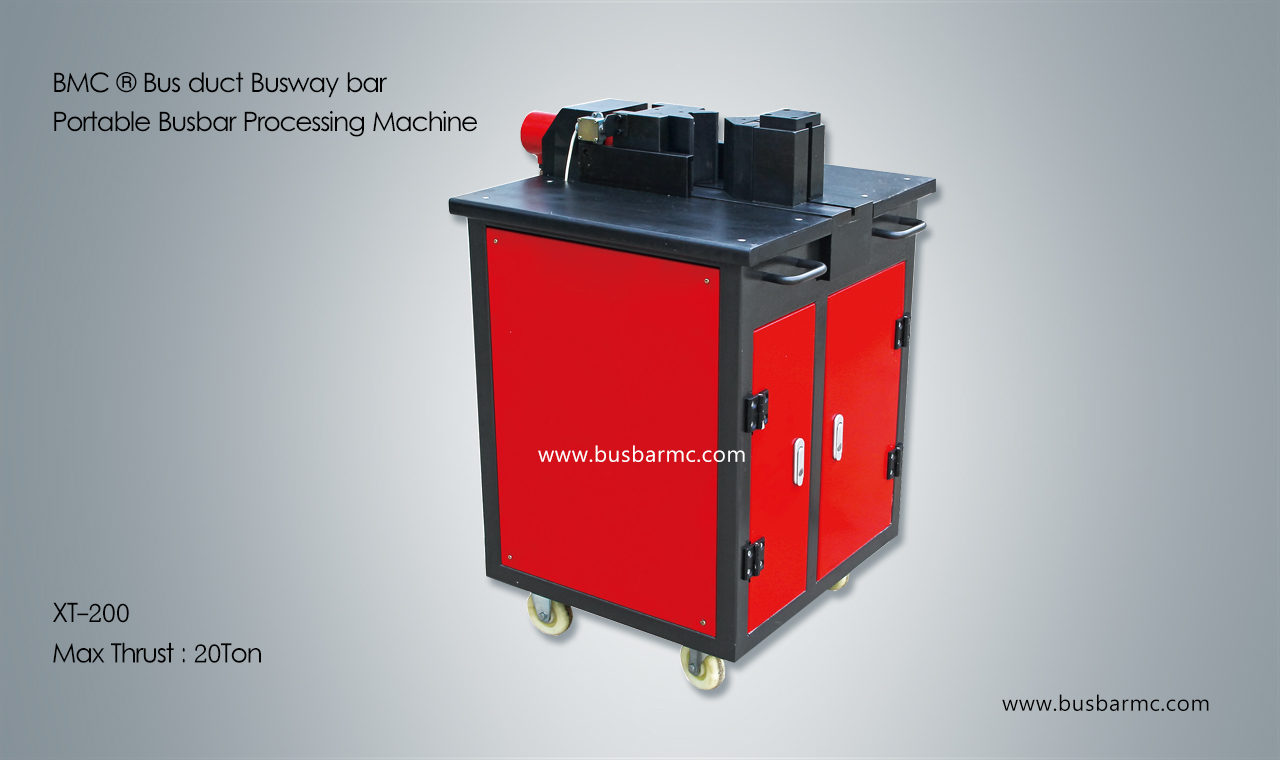
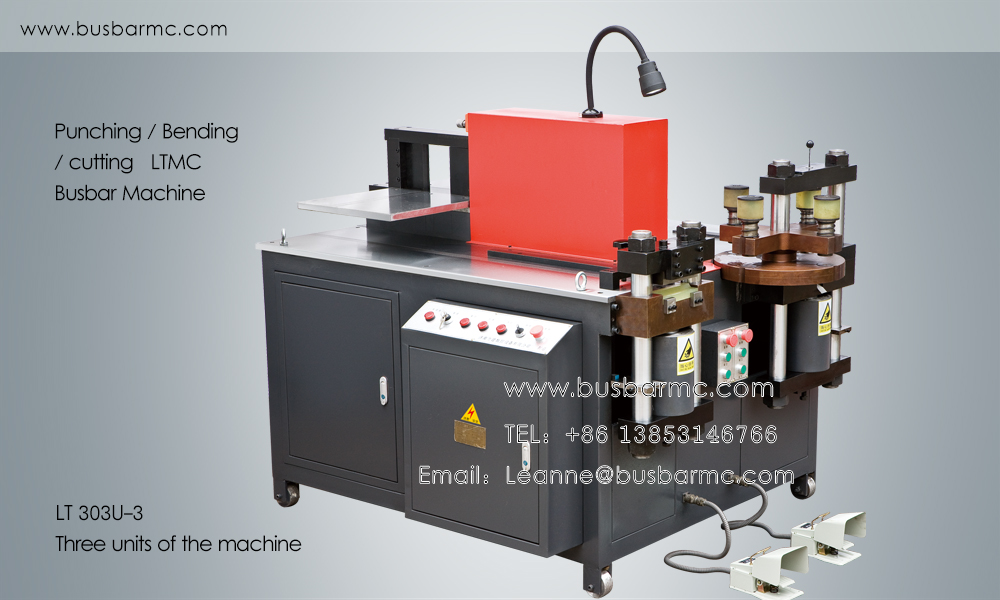
A busbar machine is workshop equipment that cuts, punches and bends flat copper or aluminum conductor bars for switchgear, transformers and distribution panels. A three station model performs all three operations on a single frame, so one bar goes from raw stock to a finished part without being re-clamped on separate tools. Capacity is set by maximum bar width and thickness, the largest hole diameter and the tightest bend the die set can form.
What a busbar machine actually does
Busbars replace cable harnesses inside electrical cabinets. They carry high current with a rigid, repeatable geometry, which means every part must match the drawing in three dimensions: length, hole pattern and bend angle. A busbar machine exists to hold those three dimensions inside tolerance at production speed. Manual sawing, drilling and press brake work can produce a single good part, but it cannot repeat the same part hundreds of times without drift.
The machine therefore combines three dedicated stations. The shear station sets finished length. The punch station sets hole position and diameter. The bend station sets the angle and the leg lengths. Dies, stops and controller settings carry the drawing data, so the operator positions the bar and the tooling does the measuring.
How the three stations work
| Station | What it does | What sets the result | What to check |
|---|---|---|---|
| Cutting (shear) | Cuts the bar to finished length with a straight, square face | Blade clearance, hold-down pressure, hydraulic stability | Cut face squareness, tear zone on the offcut |
| Punching | Forms round, oblong, square or rectangular holes, and chamfers | Die alignment, die clearance, tonnage margin for thickness | Hole position on the first part, burr height, die wear |
| Bending | Forms flat bends, edge bends, and U, Z or L shapes | Die radius, angle control, springback compensation | Angle after unload, leg length, die marks on the surface |
On many three station machines the three stations have independent motor and pump groups. That lets one operator cut while a second operator punches and a third bends, or lets a single operator run the stations in sequence without waiting for a shared hydraulic circuit to recharge. Throughput still depends on loading, handling and fixtures, not on the pump count alone.
Typical capacity classes
Published capacity tables usually follow a simple pattern: a nominal force in kilonewtons, a maximum bar width and thickness, a punching diameter range and a separate, smaller envelope for edge bends. The table below shows a common three class range so you can see how the numbers scale. Always confirm the final figures on the order acknowledgment, because public pages and older catalogs sometimes differ by region.
| Parameter | Entry class | Mid class | Large class |
|---|---|---|---|
| Nominal force | 300 kN | 500 kN | 800 kN |
| Maximum bar width x thickness | 150 x 12 mm | 200 x 16 mm | 250 x 20 mm |
| Punching diameter range | 4.3 to 25 mm | 4.3 to 30 mm | 4.3 to 34 mm |
| Vertical (edge) bend | 10 x 100 mm | 12 x 120 mm | 12 x 120 mm |
| Bending accuracy | about +/-1 degree | about +/-1 degree | about +/-1 degree |
Read the table from the hardest part backwards, not from the average part forwards. If your heaviest repeat job is a 200 by 16 mm copper bar with a 30 mm hole and a 90 degree edge bend, the entry class machine will not do it, even if most of your other work is small.
Copper and aluminum are not the same job
Copper and aluminum behave differently under the same die. Aluminum springs back more after the load is released, needs a larger minimum inside radius for the same thickness, and tends to smear or gall on tooling that is perfectly happy with copper. A bend program written for copper will usually produce an open angle on aluminum. Keep separate springback tables, keep separate die sets where surface finish matters, and prove every new material with a trial bend before the first production bar.
The same rule applies to punching. Aluminum needs more clearance and a sharper, well polished punch face to avoid pick-up on the die. Copper tolerates tighter clearance but work hardens at the cut edge, which shortens blade life if the same station also shears aluminum.
How to choose a model in five steps
- List the hardest repeating part, not the average one: maximum width, maximum thickness, largest hole and tightest bend.
- Map that part onto the published capacity table and pick the class with a margin, not the class that only just fits.
- Confirm the die package: punch shapes, bend radii, U die, and whether a twist or emboss option is needed.
- Confirm the electrical build for your site: voltage, frequency, phase, and the language of the controller interface.
- Require a factory acceptance test on your own sample drawings before shipment, and repeat the critical sample on site after installation.
What to send for an accurate quotation
A drawing beats a description. Send the material and temper, the maximum bar size, a hole list with diameters and positions, a bend list with angles and directions, the required tolerances, the monthly volume, the site voltage and the destination country. With those seven items a supplier can quote a specific machine and a specific die package instead of a generic offer that has to be renegotiated later.
Frequently asked questions
What is the difference between a busbar machine and a press brake?
A press brake bends sheet metal with a punch and a V die over a long bed. A busbar machine is built around thick, narrow bar: it shears to length, punches holes in a turret or die block, and bends with a dedicated busbar die set. A press brake can bend a busbar, but it cannot cut it to length or punch a hole pattern in the same setup.
Can one machine cut, punch and bend the same bar?
Yes on a three station machine. The bar is cut to length, moved to the punch station for its hole pattern, then to the bend station. On machines with three independent hydraulic units the stations can also run at the same time with three operators.
What thickness can a busbar machine process?
Common published maximums run from about 12 mm on an entry class machine to about 20 mm on a large class machine, at the matching maximum width. Thickness and width are linked: a 250 mm wide bar cannot be sheared at the same thickness as a 150 mm bar on the same machine.
Do I need a CNC controller?
A CNC or PLC controller pays for itself when you repeat the same parts. It stores bend programs, compensates springback and lets an operator recall a job instead of re-teaching it. For one-off repair work a manual machine is enough.
How long does it take to learn to operate one?
A trained press brake or panel shop operator can run basic cutting and punching within a day. Bending to a repeatable angle across different materials takes longer, because springback compensation has to be learned per material and per die. Plan on structured training on the actual machine, not on a manual.