Türkçe
 English
 فارسی
 اللغة العربية
 Deutsch
 Français
 русский язык

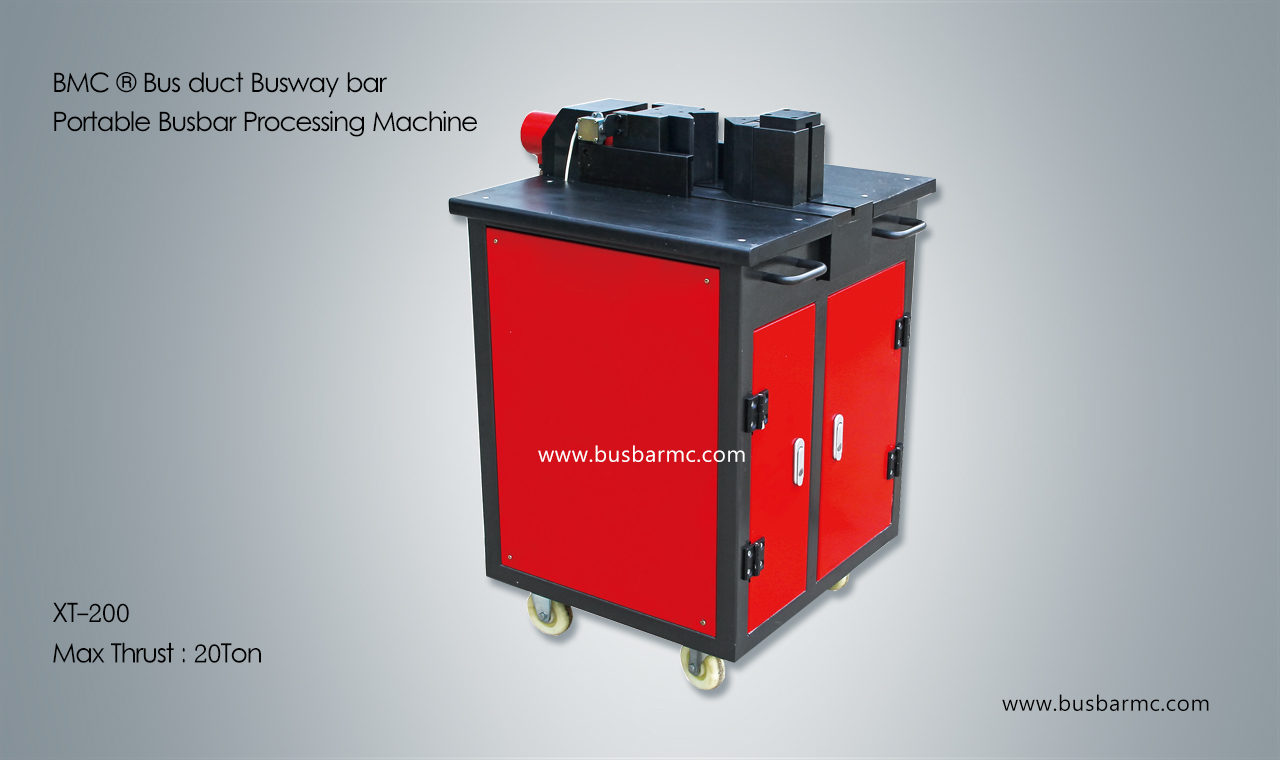
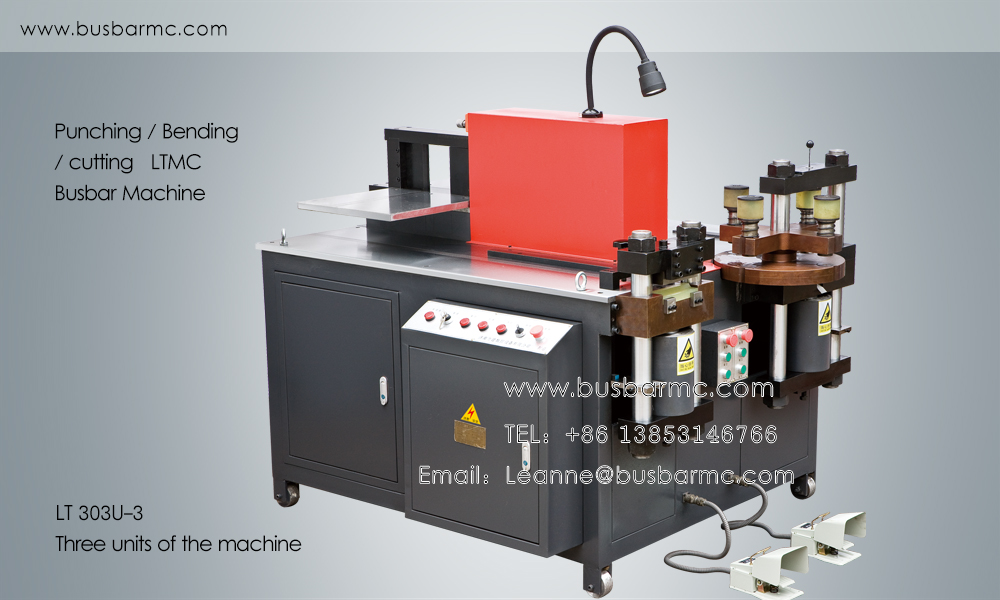
A three station busbar machine combines punching, shearing and bending on one frame, so a copper or aluminum bar for switchgear or distribution equipment can be finished without moving between three separate machines. The three hydraulic units can run in parallel with three operators or in sequence with one. Class is set by nominal force and by the maximum bar width and thickness the shear and bend stations accept, not by the number of stations.
What the three classes mean in practice
| Parameter | 303 class | 503 class | 803 class |
|---|---|---|---|
| Nominal force | 300 kN | 500 kN | 800 kN |
| Maximum bar width x thickness | 150 x 12 mm | 200 x 16 mm | 250 x 20 mm |
| Punching diameter range | 4.3 to 25 mm | 4.3 to 30 mm | 4.3 to 34 mm |
| Maximum vertical bend | 10 x 100 mm | 12 x 120 mm | 12 x 120 mm |
| Motor power | 3 x 4 kW | 3 x 5.5 kW | 3 x 5.5 kW |
| Approximate mass | 1400 kg | 1700 kg | 2100 kg |
The jump from 303 to 503 buys 50 mm of width, 4 mm of thickness and 5 mm of hole diameter. The jump from 503 to 803 buys another 50 mm of width, another 4 mm of thickness and 4 mm of diameter, but no increase in vertical bend capacity and no increase in motor power. That last detail matters: if your work is dominated by edge bends rather than wide flat bars, the 803 class does not solve the problem.
Station by station
Punching station
A six position turret keeps several die sizes centred and ready, which is what makes short runs economic. Published ranges run from about 4.3 mm to 25, 30 or 34 mm depending on class. Below 4.3 mm the punch becomes slender and the risk of snapping rises, so small holes are usually better drilled or punched on a dedicated press. Above the upper limit the tonnage required grows faster than the die area, and the machine frame becomes the limit.
Cutting station
The shear sets finished length. What matters is the quality of the cut face, because a torn face creates a stress riser and a poor contact surface. A common workshop target is a tear zone under about 25 percent of the thickness, measured on the offcut. Treat that as an acceptance criterion on the factory test, not as a marketing phrase.
Bending station
The bend station carries the mode library, the angle control and the springback tables. Standard dies commonly cover radii from about 3 mm to 10 mm, plus a large radius die and a U die. Two bends closer than roughly 40 mm need an engineering check, because the second bend may not clear the die that formed the first.
When a three station machine is the wrong answer
If a single process dominates your workload, a dedicated machine wins. A shop that punches thousands of holes per shift but rarely bends will get more output from a dedicated punching line than from a shared frame, because the shared frame is idle in two of its three stations for most of the day. The three station layout wins when the mix is genuinely mixed and floor space is limited, which describes most panel building shops.
The second wrong answer is buying the class that only just fits today. Bars do not get thinner over time, and a machine bought at the exact limit of the current job has no room for the next one. One class up is usually cheaper than a second machine.
Frequently asked questions
Can all three stations work at the same time?
Yes when the machine has three independent motor and pump groups, which is the usual configuration for this class. Three operators can then punch, cut and bend simultaneously. Throughput still depends on loading and handling, so the practical gain is smaller than three times.
Do I need a three station machine for aluminum as well as copper?
The machine handles both, but the tooling and the compensation tables do not transfer automatically. Aluminum needs more clearance, a larger minimum inside radius and a larger springback value. Keep separate die sets if surface finish matters.
What should be confirmed before ordering?
Die package, voltage and frequency, controller language, the springback procedure for each material, and the acceptance test samples. Those five items cause more installation delays than any mechanical specification.